
Visibility of Reason for Failure of Connectors
1. Overview
When a connector sync fails, the Knowledge Management (KM) dashboard tells you three things in one place: what failed, why it failed, and what to do next.
Every failure carries a unique error code, is classified into a category and sub-reason, and is accompanied by actions you can take directly from the dashboard — retry the sync, open the execution logs, or reach Leena AI support. Administrators can diagnose and resolve most sync failures without raising a ticket.
2. Where you see it
Failure details appear in two places, and both open the same view:
- Sync Logs — go to Knowledge Management → Sync logs → Connector sync logs. A failed run shows a Sync failed status chip; hover to see View failure details, and click to open the sync drawer.
- Connector settings — open the connector under Settings → Integrations and click into the sync run.
Related status chips you may see on the same screen:
| Chip | Meaning |
|---|---|
| Sync failed | The run failed. Click to see the error code and reason. |
| Partially synced | The run completed, but some articles could not be synced. Each problem is listed with its own code. |
| Sync stopped | Someone cancelled the run. No articles from that run are available. This is not a failure and has no error code. |
| Request timed out | The connector did not respond within the expected window. |
3. What the failure card shows
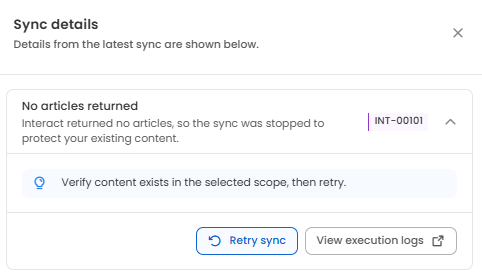
The drawer opens on a failure card containing:
| Element | Example |
|---|---|
| Sub-reason (card title) | Authentication failed |
| What happened (card description) | Your ServiceNow connection has expired or no longer has the required permissions. |
| Error code (chip on the right) | SNW-00201 |
| What to do (highlighted bar) | Reconnect ServiceNow or update its permissions in Connector settings, then retry the sync. |
| Actions | Retry sync, View execution logs (or Need help) |
The sync progress timeline in the same drawer marks the step that failed, showing Error <code> : <sub-reason> against that step — so you can see whether the run broke at discovery, at content fetch, at permission sync, or at indexing.
4. Actions available on a failure
| Action | What it does | When it appears |
|---|---|---|
| Retry sync | On the connector's settings page, re-runs the sync immediately. From Sync Logs, takes you to that connector's settings page, where the sync can be triggered. | Always on a failure card. Disabled while a sync is already running for that connector, and on connections that cannot be re-synced from the current environment. |
| View execution logs | Opens Integrations → KM connectors → Execution logs, filtered to the connector's API activity, so you can see the exact calls and responses behind the failure. | For Auth / Permission and Source failure categories, and on every article-level failure group. |
| Need help | Opens the Leena AI support portal so you can raise a ticket. | Instead of View execution logs when the category is Internal error — these are failures inside the Leena AI platform, where execution logs will not tell you anything actionable. |
5. Error code structure
Every code has the shape E-<PREFIX><SUFFIX> — for example E-SNW00201. In the dashboard the code is displayed as PREFIX-SUFFIX, so E-SNW00201 is shown as SNW-00201.
E— Error.PREFIX— a 3-letter code identifying the connector.SUFFIX— a 5-digit code identifying the failure. It is the same across all connectors, so00201always means "authentication failed", whichever connector reported it.
Connector prefixes
| Connector | Prefix | Connector | Prefix |
|---|---|---|---|
| Box | BOX | ServiceNow | SNW |
| Confluence | CNF | SFTP | SFT |
| Google Drive | GDR | SharePoint (Graph) | SPG |
| Interact | INT | Unily | UNL |
| Salesforce | SFC | Workday | WRK |
| Zendesk | ZDK | Any other / custom source | CON |
6. Error code reference
Codes are grouped into three categories. The first group of digits indicates the series: 001 source-side, 002 access-related, 003 internal.
Auth / Permission
| Code | Sub-reason | What it means and what to do |
|---|---|---|
00201 | Authentication failed | The connection has expired or the credentials are no longer valid. Reconnect the source or update its permissions in Connector settings, then retry. |
00202 | Permission denied | The account Leena AI uses does not have access to the requested content. Grant access at the source, then retry. |
00204 | Request rejected by source | The source rejected the request. Check the connector configuration, then retry. |
Source failure
| Code | Sub-reason | What it means and what to do |
|---|---|---|
00100 | Source server error | The source was unreachable during this sync. Usually temporary — retry once the source is back up. |
00101 | No articles returned | The source returned no articles, so the sync was stopped to protect your existing content. Verify content exists in the selected scope, then retry. |
00102 | Network error | The connection to the source dropped. Usually temporary — retry. |
00203 | Rate limit exceeded | The source is temporarily limiting requests. Retry after some time. |
00205 | Partial access | Part of the selected scope could not be read. Check access to the affected sites, spaces or folders, then retry. |
00206 | Empty article | The affected articles have no content at the source. Add content at the source, then retry. |
00207 | Not found at source | The affected articles could not be found. They may have been moved or deleted at the source. Retry, and check they still exist if the error repeats. |
Internal error
| Code | Sub-reason | What it means and what to do |
|---|---|---|
00300 | Unknown error | An unexpected error inside the Leena AI platform. Retry the sync; use Need help if it repeats. |
00301 | Connector error | A failure in the connector service. Retry the sync; use Need help if it repeats. |
00302 / 00303 | Internal Server Error | A failure while handing content to the Knowledge Management or NLP service. Retry the sync; use Need help if it repeats. |
A code that is not recognised is shown as Internal error : Unknown error with the raw code preserved on the card, so it can still be quoted to support.
7. Article-level failures (partially synced runs)
When a run completes but individual articles could not be processed, the drawer lists them grouped by problem — for example empty content, corrupted file, file too large, unsupported file type, permission denied, or not found. Each group shows:
- the number of affected articles, with the article name and a link to the item at the source,
- the error code for that group (for example
GDR-00206), - a short explanation of the problem, and
- Retry sync and View execution logs.
This makes it possible to fix a handful of articles at the source and re-run, rather than treating the whole sync as failed.
8. Protective stop on an empty source
If a sync discovers zero articles at the source, Leena AI fails the run on purpose rather than removing your existing content. Nothing is deleted from Knowledge Management. Check that content still exists in the selected scope — the folders, spaces, sites or knowledge bases mapped in the connector — and that the account Leena AI uses can still see it, then retry.
Updated about 1 month ago