
Bot Settings in KM
Overview
This document provides an overview of the bot settings available in the KM dashboard.
Bot Settings in KM
To navigate to the bot settings in KM, go to Settings → General → Bot settings. Click Edit to modify the settings. These settings are available to KM admins only.
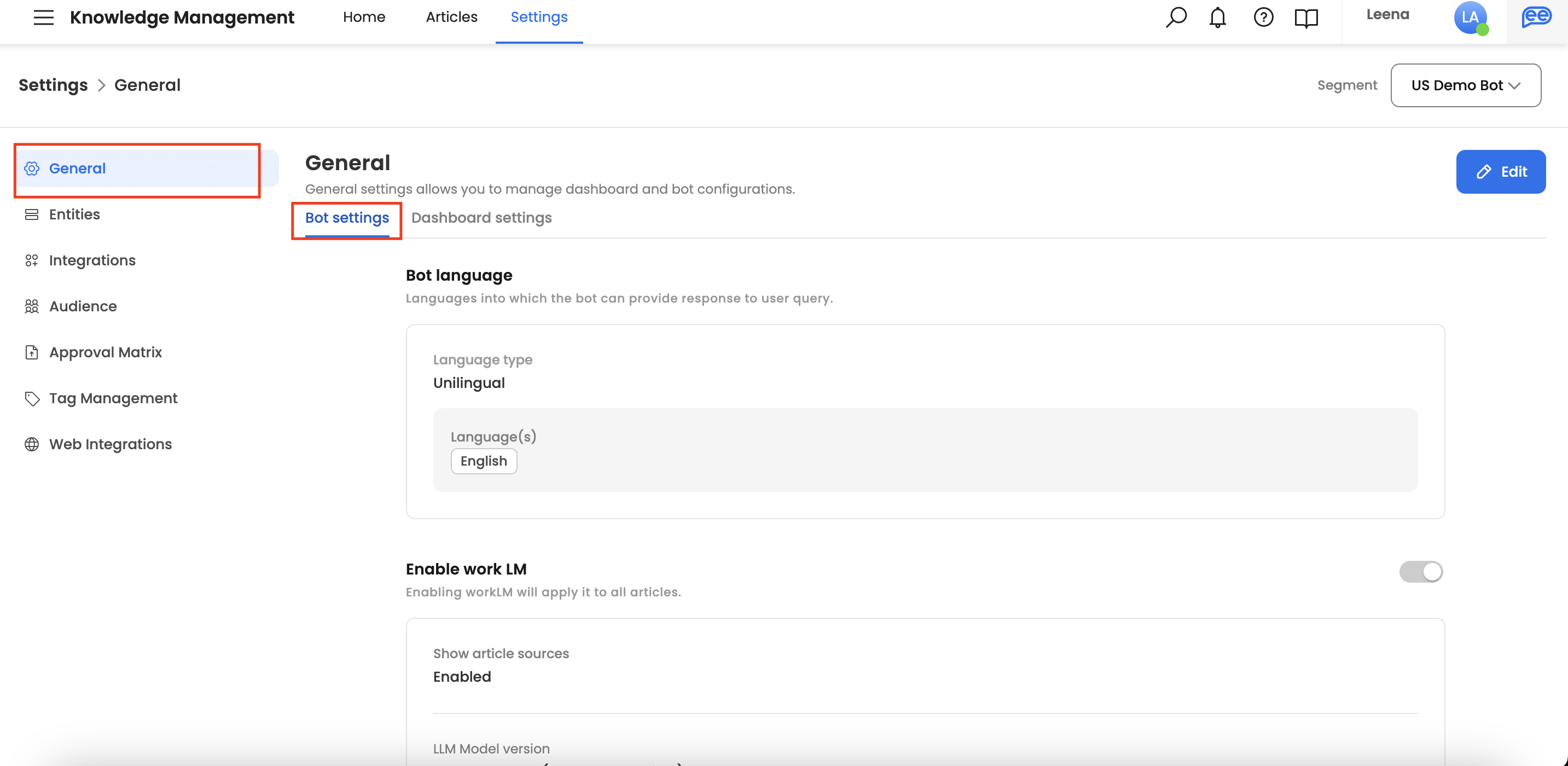
Settings → General has three tabs: Bot settings, Dashboard settings, and Article visibility. The Bot settings tab is not shown when the Master segment is selected — bot settings are always configured against a specific segment (or the base configuration where segments are not in use).
Non-production botsBot settings on UAT and Staging bots are read-only. The dashboard shows the message "This view is read-only and reflects production settings. To make changes, update the settings in the production environment." and the Edit option is disabled.
Settings saved on the Production bot are replicated down to the lower environments automatically, so Production is the single place to change them. Refer to Environments in KM.
Types of Settings
Bot settings are grouped into four sections: Bot language, Knowledge Search Configurations (which contains Bot response settings and Search pipeline settings), and Policy hub webview.
Bot language
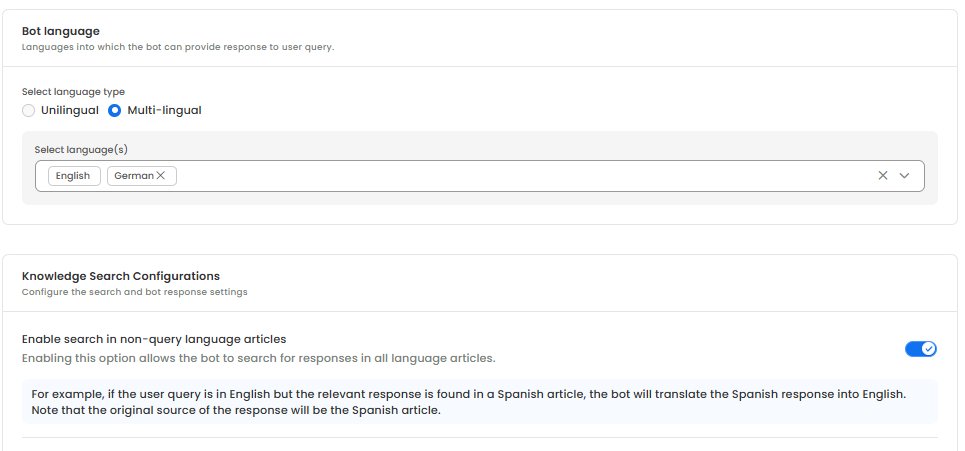
Users can configure the supported bot languages directly from the KM dashboard. These selected languages determine the ones in which users can upload articles in KM, and enable the bot to respond using those articles.
- Select language type: choose Unilingual or Multi-lingual.
- Select language(s): available when the language type is Multi-lingual. English is always included and cannot be removed.
By default, all bots are set to English as a unilingual setting, which can be customised as needed.
Knowledge Search Configurations
Configure the search and bot response settings.
-
Enable search in non-query language articles: shown for multi-lingual bots only. Enabling this option allows the bot to search for responses in articles of all languages.
- For example, if the user query is in English but the relevant response is found in a Spanish article, the bot translates the Spanish response into English. Note that the source of the response will be the Spanish article.
-
Show article sources: controls the visibility of source articles in bot responses. Disabling this toggle hides 'Source Articles' in the bot's responses.

-
LLM Model version: see LLM Model below.
-
Abbreviations: define company-specific abbreviations for the model to understand. Each row takes an Abbreviation and its Full Form; both are required.
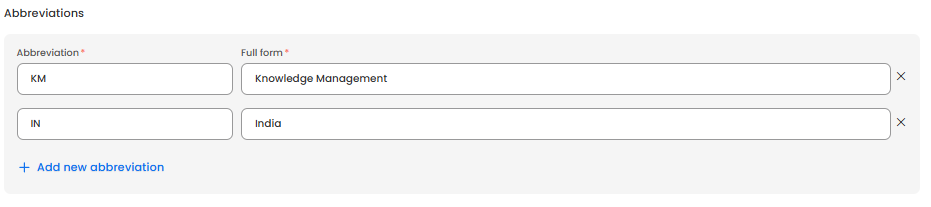
For example: "KM" stands for "Knowledge Management" at Leena AI. This helps generate and frame responses where the user query or the response contains an abbreviation.
-
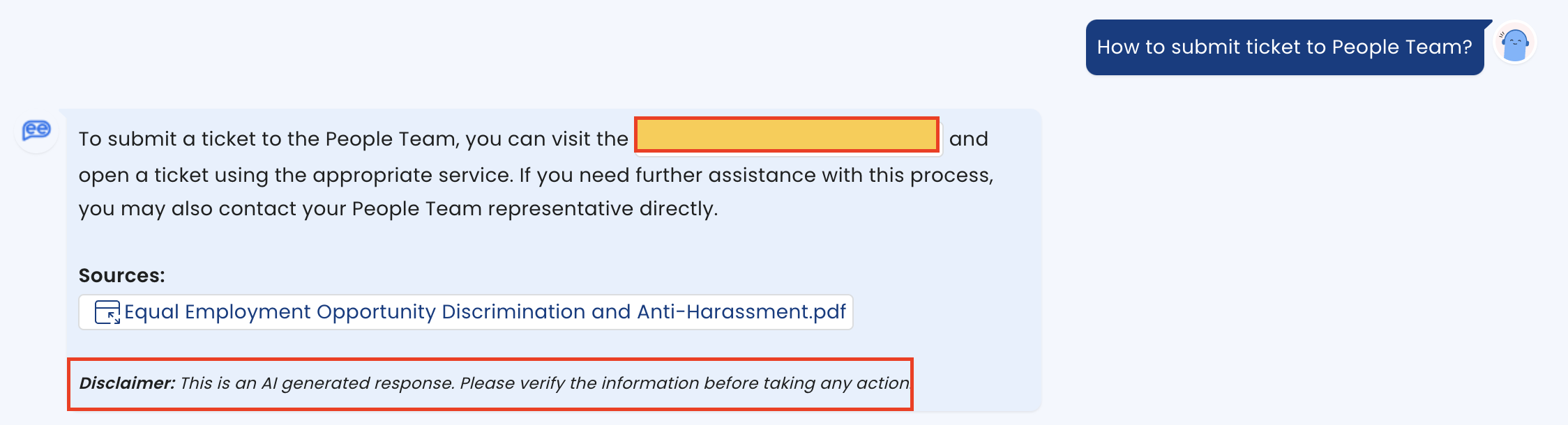
Disclaimer for responses: adds a disclaimer message at the end of the bot response.

-
For example: "This message has been generated by an AI model."
-
On multi-lingual bots, the disclaimer text can be Common for all languages or Specified for individual languages.
-
Each disclaimer is limited to 500 characters.
-
Note: The disclaimer is shown in the bot after every generated response.
LLM Model

The model used to generate KM responses is selected here. There are two options, described by outcome rather than by model version:
| Option | Label in the UI | When to use it |
|---|---|---|
| Smaller model | Smaller model (Reliable and Fast) | The default for most deployments. Lower latency, and sufficient accuracy for the large majority of policy and knowledge queries. |
| Larger model | Larger model (Highly Accurate and Slow) | Where content is dense, heavily tabular, or reasoning-intensive, and answer quality matters more than response time. |
A help link is shown next to the setting, opening Model Selection for Knowledge Management, which explains the trade-off with reference to the latest benchmarking.
Points to note
- The two labels are stable. The underlying model version behind each option is updated by Leena AI as newer models are validated, without any change to the setting or any action required from an admin.
- Changing the model takes effect on new queries. Content does not need to be re-synced.
Bot response settings
Configure how your knowledge content is displayed in answers.
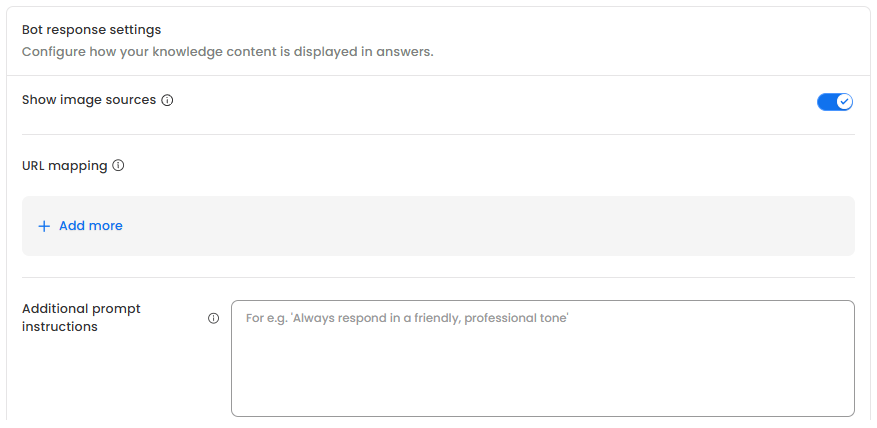
| Setting | What it does |
|---|---|
| Show image sources | Displays images from article sections (like diagrams or screenshots) in the answer's source view. |
| URL mapping | Adds specific URLs to certain phrases in the answer's source view. Each row takes a Text value (for example, 'Notes') and a URL (for example, 'https://docs.acme.com'). Both are required, and the URL must be valid. |
| Additional prompt instructions | Free-text guidelines that shape the tone or behaviour of all bot responses — for example, "Always respond in a friendly, professional tone". These instructions are applied to every generated response for the bot. |
Additional prompt instructions apply to answer generation only. They do not change which articles are retrieved, and they cannot be used to grant access to content the user is not entitled to see.
Search pipeline settings
Set personalization and refinement preferences for your bot's search pipeline.
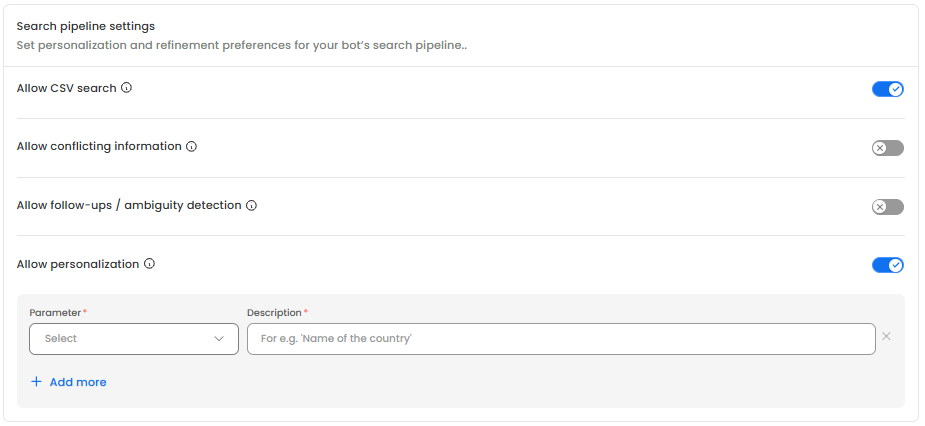
| Setting | What it does |
|---|---|
| Allow CSV search | Includes data from CSV and Excel files when searching for answers. |
| Allow conflicting information | Surfaces conflicting information in the bot response where two or more sources disagree. See Conflict Analysis within KM. |
| Allow follow-ups / ambiguity detection | Allows the system to ask a clarifying question when the query is ambiguous — for example, when it could map to two or more distinct categories such as different leave types or insurance plans. |
| Allow personalization | Tailors responses using employee data such as department or location. See Response Personalization. |
Personalization parameters
When Allow personalization is switched on, a list of parameter rows appears:
- Parameter — selected from the employee parameters synced for the bot. A parameter can only be mapped once.
- Description — what the parameter means, in plain language, so the model knows when and how to apply it.
Both fields are required on every row.
Keep the number of personalization parameters as low as the use case allows. Each parameter is additional context the model has to weigh for every query; a small, well-described set produces sharper and more useful answers than a long list.
Policy hub webview
Pin important policies in the policy hub and control whether managers can access policies for their reportees.
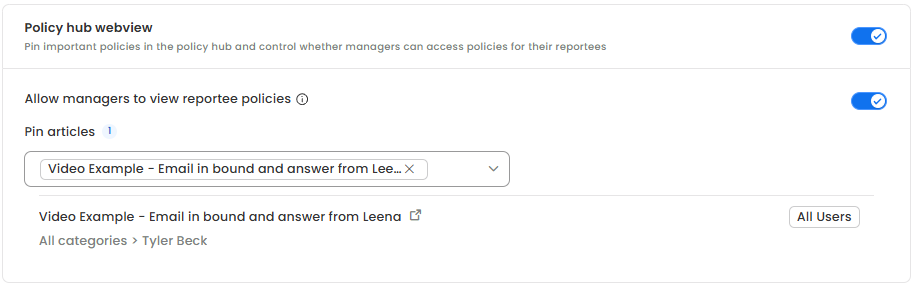
| Setting | What it does |
|---|---|
| Policy hub webview | Enables pinning of articles in the Policy Hub. When switched on, use Pin articles to search and select the articles to pin. Only the selected articles remain pinned; any previously pinned article that is removed from the list is unpinned. |
| Allow managers to view reportee policies | Allows managers to view the articles that apply to their direct reportees. When this is off, reportee-scoped requests are rejected. |
See Pinning KM Articles in Policy Hub and Policy Hub: Managerial View & Enhanced Search.
How changes take effect
- Bot settings are saved against the Production bot for the selected segment, and are then replicated to the lower environments (Pre-prod, UAT, Staging) so that all environments stay in parity.
- Changes apply to new queries. Articles do not need to be re-synced after changing any of these settings.
- Changes to bot settings are captured in the audit logs, including who made the change and what changed. See Audit Logs.
Updated about 1 month ago