
Reporting and Analytics
Watch the tutorial
Use the Notification Analytics page to understand who your notification reached, on which channels, and how people engaged with it
You can quickly answer:
- Did this notification reach my audience?
- Which channels worked (email, WhatsApp, Teams, etc.)?
- How many people opened or interacted with it?
- Where did it fail?
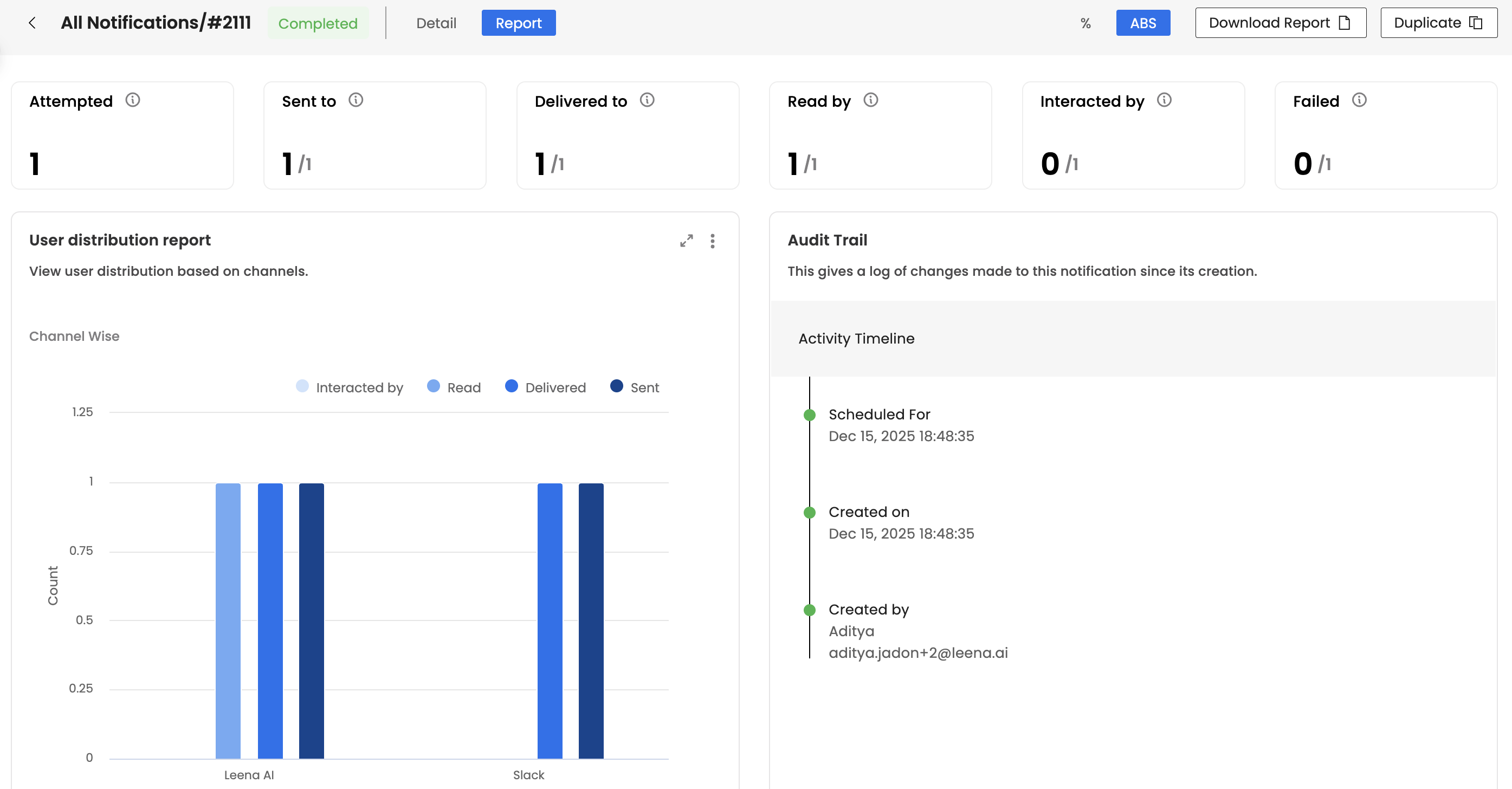
1. What you’re looking at
A notification instance is one send of a message (for example, “Survey reminder – 15 Jan 10:00 AM”) to an audience of users.
The page shows this notification at three levels:
- Overall notification metrics – across all users and all channels.
- Per channel metrics – how this notification performed on each channel (Email, WhatsApp, etc.).
- Per user details – what happened for each user, and on which channels.
2. Key metrics (per notification instance)
For each metric in the notification overview, you’ll see:
X users, out of Y applicable users
- X = number of users where the metric is “Yes” (or “No” in case of failures), depending on what is shown.
- Y = total unique users for whom that metric is applicable (we know if it’s Yes or No).
- Users with “Not available” or “Not applicable” status are not counted in Y.
This helps you see both how many users a metric applies to, and a correct percentage based only on users where that information actually exists.
Attempted
- Users we tried to send this notification to.
- This should match your audience size.
- Shown as:
- Attempted: X users (for Attempted, applicable users = full audience).
Sent
- Users where the notification was successfully sent on at least one channel.
- If Sent < Attempted, some sends failed (e.g. missing channel users, invalid addresses).
- Shown as:
- Sent: X users out of Y applicable users.
Delivered
- Users we know received the notification (delivery confirmed by the channel).
- Only users where delivery status is known are counted as “applicable”.
- Shown as:
- Delivered: X users out of Y applicable users
- Y = users with Delivered = Yes or No.
Read
- Users who opened or saw the notification (for channels where read tracking is available).
- Only users with a known read status are counted as “applicable”.
- Shown as:
- Read: X users out of Y applicable users
- Y = users with Read = Yes or No.
Interacted
- Users who took action from the notification (clicked, answered, approved, etc.).
- Only users for whom interaction is possible and tracked are “applicable”.
- Shown as:
- Interacted: X users out of Y applicable users
- Y = users with Interacted = Yes or No.
Failure
- Users for whom the notification failed on all channels (no channel succeeded).
- Typically comes with a technical reason (invalid address, missing channel user, provider error, etc.).
- Shown as:
- Failed: X users out of Y applicable users
- Y = users with Failure = Yes or No.
3. Channel breakdown (per notification, per channel)
Use the channel view to compare performance across channels for the same notification, for example:
- Is Email doing better than WhatsApp?
- Is one channel causing most failures?
4. User‑level details (per notification, per user)
Use the user details view to check what happened for a specific person:
- A user says “I didn’t receive this message” → search for them here.
- See:
- Their overall status (Attempted, Sent, Delivered, Read, Interacted, Failure) across all channels.
- A breakdown per channel: which channels delivered, were read, had interactions, or failed (with reasons).
If at least one channel succeeded, the user is considered reached, even if another channel failed.
Updated 8 months ago