
Studio Assist
Studio Assist
BETA — Studio Assist is available in AI Colleague Studio. It is read-only: it can investigate, explain and summarise, but it cannot change your configuration.
Studio Assist is a conversational assistant built into AI Colleague Studio. It sits alongside whatever page you are on, already knows which bot, AI Colleague or run you are looking at, and answers questions about your AI Colleagues in plain language — with charts, tables and timelines instead of raw logs.
It is designed for the people who build and operate AI Colleagues: implementation teams, support engineers, and admins who need to answer "why did this fail?" or "how are we doing this month?" without stitching together the Debugging Console, Run History and Reporting by hand.
Watch the Tutorial
Opening Studio Assist
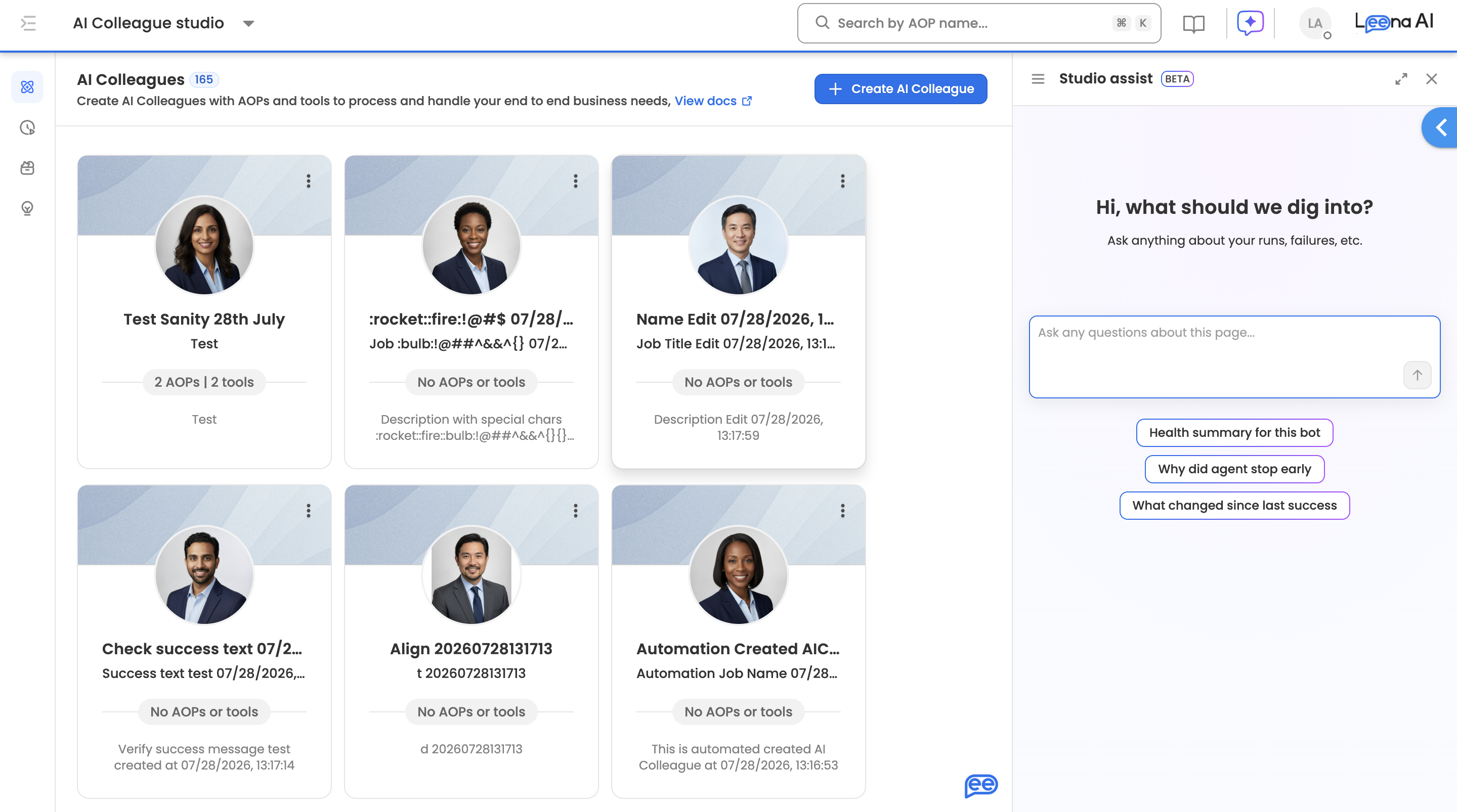
| Action | How |
|---|---|
| Open / close the panel | Click the Studio assist sparkle icon in the top bar (left of your profile avatar) |
| Keyboard shortcut | Cmd + J (Mac) / Ctrl + J (Windows) |
| Expand to full screen | Click the expand icon in the panel header |
| Close | Click the close icon, or press Esc |
The panel opens as a side sheet on the right. The page you are on stays fully usable — you can click around, open a run, or switch tabs while the conversation stays live. The side menu collapses automatically while the panel is open to give the page more room; hover over the rail to peek at it.
A new conversation opens on the welcome screen — "Hi, what should we dig into?" — with a short set of suggested starter questions below the composer.
Availability
- Studio Assist appears only on AI Colleagues pages today (AI Colleague listing, AOP details, Tools, Workbench, Run History, Run Execution details, Debugging Console). Other modules will be added over time.
- The icon does not appear at all if your region has not been provisioned for Studio Assist.
Page awareness
Studio Assist reads the context of the page you are on and uses it to resolve what "this" refers to. You do not have to paste IDs. The composer placeholder — "Ask any questions about this page…" — reflects exactly that.
What it picks up:
- The bot and environment you are working in
- The AI Colleague open on screen
- The run / request open on screen (both the internal request ID and the human-readable
ID_00XXXXrun code) - The AOP, Tool or Workbench schedule open on screen
So on a run detail page you can simply ask "why did this fail?" or "summarise this run", and on an AI Colleague page you can ask "how many runs did this handle last week?".
If you switch pages mid-conversation, the assistant picks up the new context on your next message.
What Studio Assist can do
1. Debug a specific run
The core use case. Studio Assist can pull the full evidence trail for any request, run code or conversation ID and explain what happened.
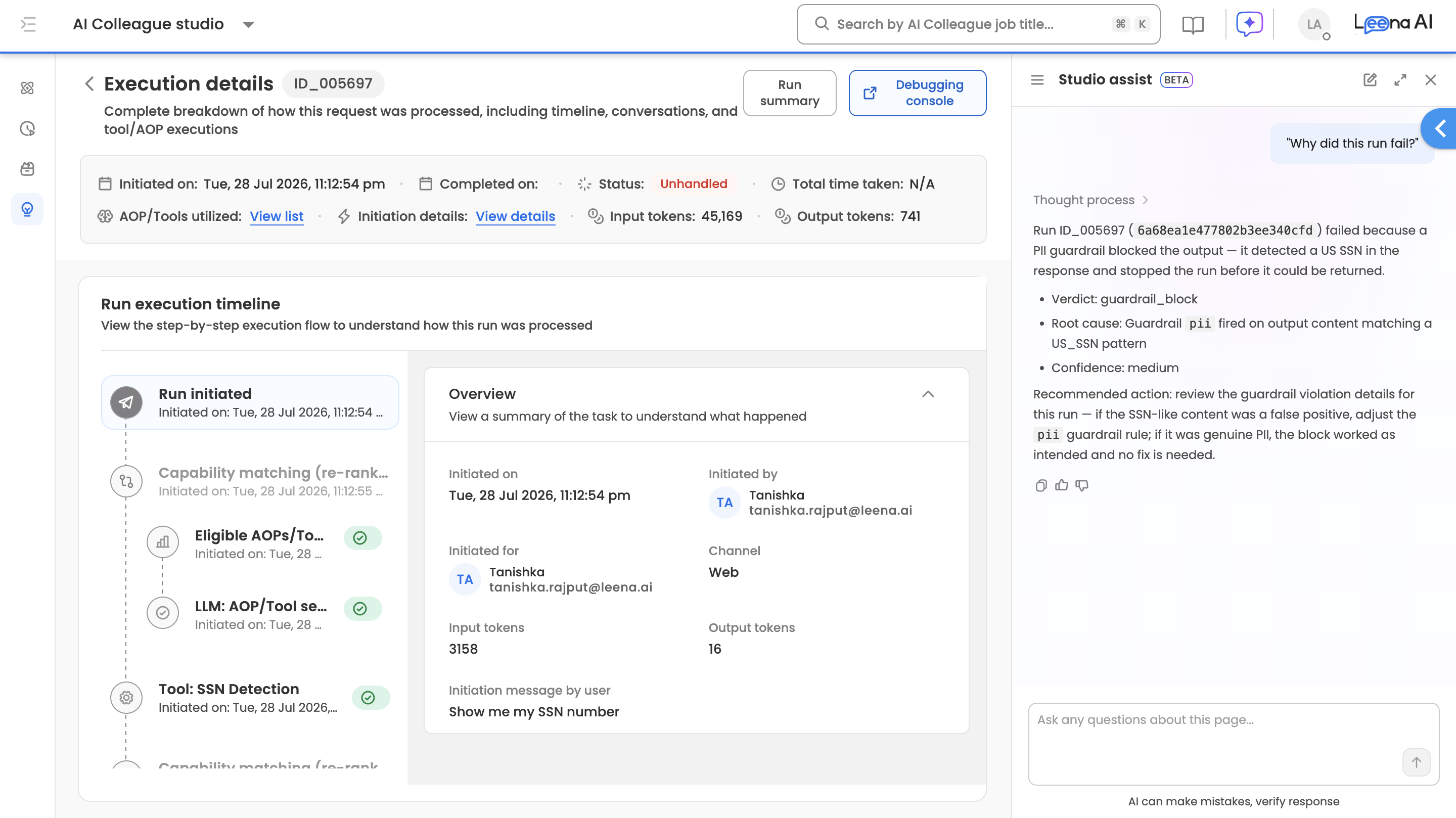
It can retrieve:
- Run overview — status, sub-status, channel, trigger type, who initiated it, timestamps, token usage, escalation and handoff state
- Execution timeline — the ordered step-by-step trace of the run
- Tool calls — every tool the AI Colleague invoked, with inputs, outputs, durations and failures (full or summarised)
- Agent chain — the orchestrator → AOP → sub-agent delegation path
- LLM interactions — the model calls made during the run, and the full prompt/response payload for any individual call
- Debug events — the raw event stream, filterable by event name
- Consolidated run evidence — a single pre-analysed bundle of the above, used for root-cause questions
Example questions
- "Why did this run fail?"
- "Show me the timeline for ID_003740"
- "Which tool calls errored in this run?"
- "What did the model actually see on call 3?"
- "Was this escalated, and why?"
2. Diagnose tool and AOP selection
When an AI Colleague picks the wrong tool — or no tool at all — Studio Assist can explain why.
- Tool selection diagnosis — compares the run against the tool you expected to fire and reports what was actually considered and chosen
- Tool availability check — confirms whether a given tool is mapped, enabled and reachable for the bot
- Tool definition — returns the tool's configured name, description, parameters and execution scope
- AOP details — returns the configuration of a specific AOP
- AOP listing — lists all AOPs on the bot, filterable by AOP type
- Bot capability listing — lists everything the bot can do, by category
- Bot configuration snapshot — the current configuration state of the bot
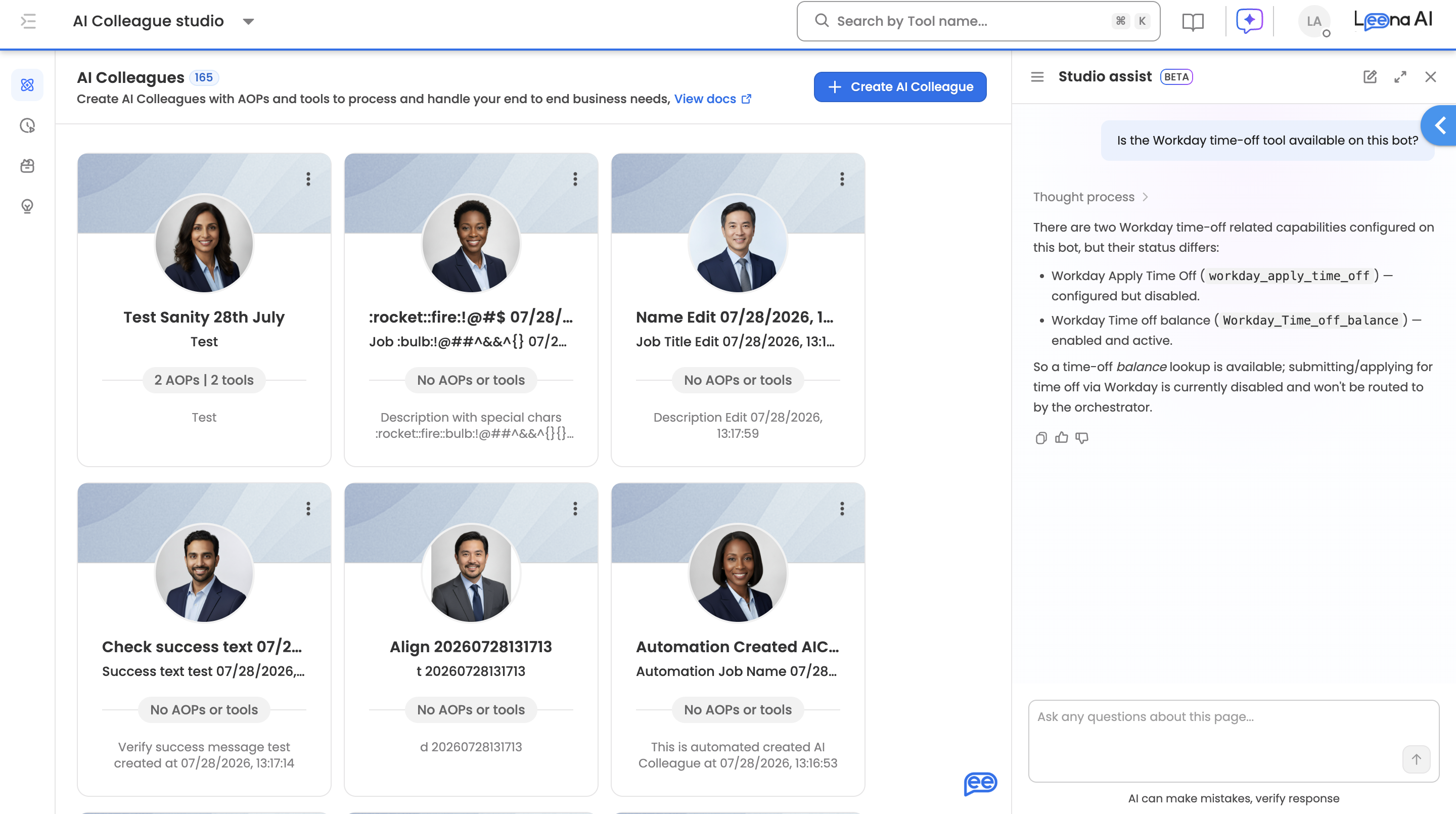
Example questions
- "Why didn't the leave-balance tool get picked here?"
- "Is the Workday time-off tool available on this bot?"
- "What does the AOP
it_password_resetdo?" - "List all the AOPs of type Task on this bot"
3. Inspect workflow execution
For AI Colleagues that call workflows, Studio Assist can go one level deeper:
- Workflow node detail — the inputs, outputs and status of a specific node in the workflow run
- Workflow node path — the full path the workflow took through the canvas
4. Search and analyse across runs
Beyond a single run, Studio Assist answers aggregate questions without you building a report.
- Search requests — find runs by status, trigger type, channel, AI Colleague, AOP, tool, initiator, escalation state, and time window (last 24 hours / 7 days / 30 days, or a custom date range). You can also free-text search by run ID, user name or email.
- Summarise requests — pre-aggregated counts and rates over a filtered set, broken down by status, trigger type, channel, escalation, schedule, AOP, tool, AI Colleague, or failure reason.
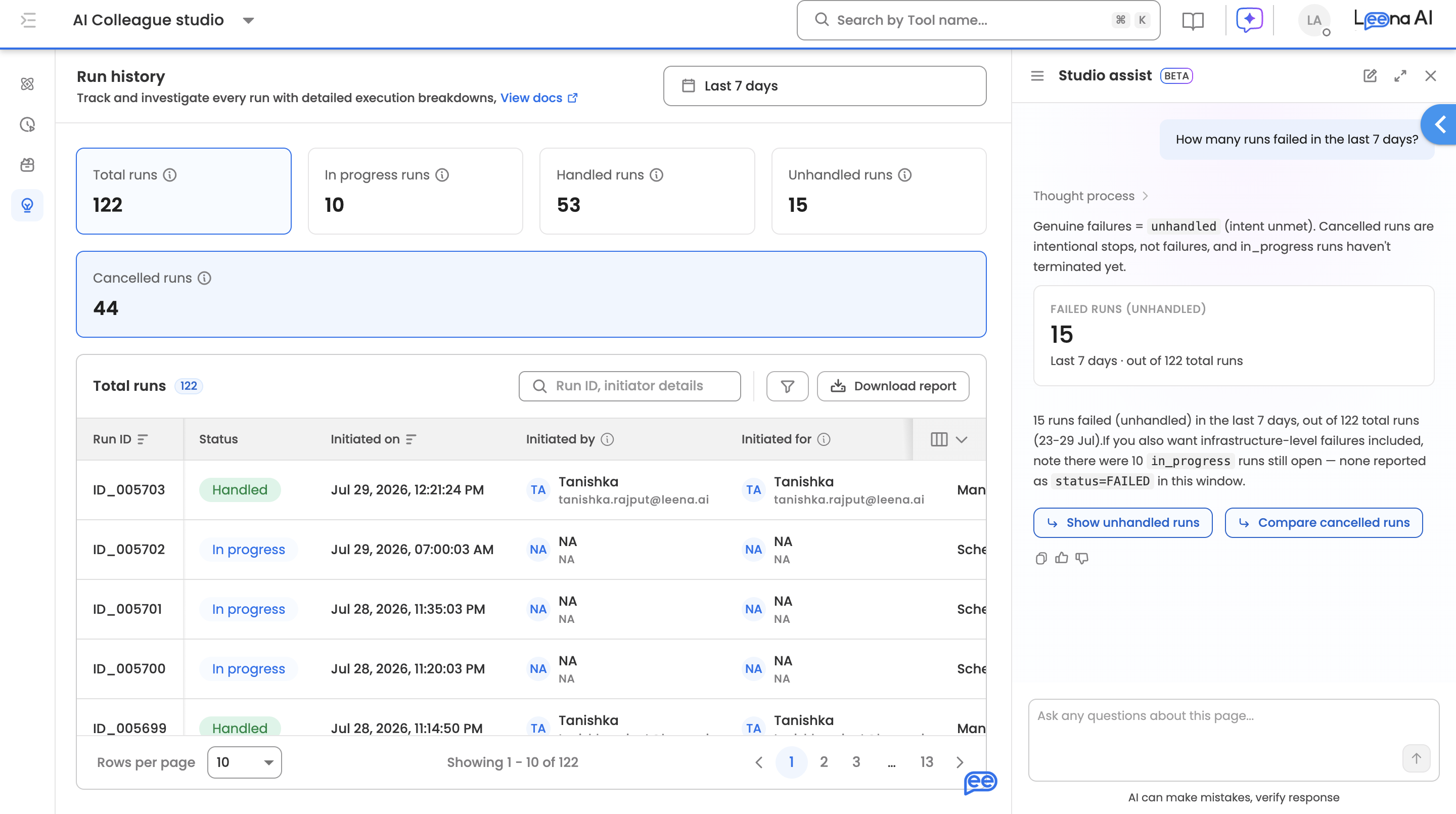
Example questions
- "How many runs failed in the last 7 days?"
- "Break down last month's runs by failure reason"
- "Show me all escalated runs on the Teams channel this week"
- "Compare handled rate this month vs last month"
- "Which AOP has the highest failure rate?"
Aggregate answers come from pre-computed rollups, not from counting rows in a list — so the numbers are consistent with what you see in Reporting.
5. Answer product "how do I" questions
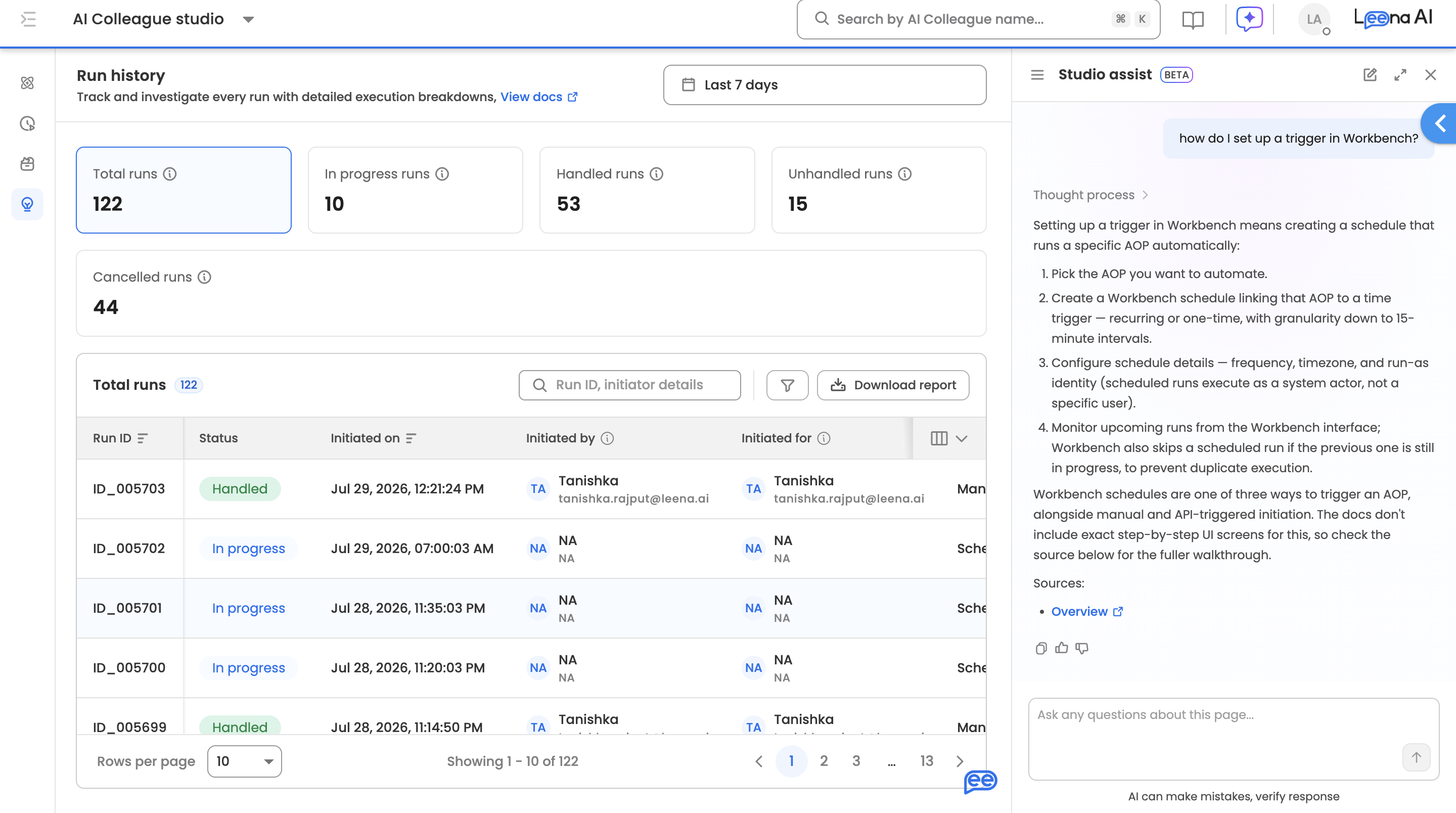
Studio Assist can search Leena AI product documentation and answer setup and configuration questions in context — "how do I set up a trigger in Workbench?", "what does AOP type Conversational mean?", "how do I write a good tool description?".
6. Guided debugging
If you are not sure where to start, ask for guidance. Studio Assist can walk you through a structured debugging approach for common problem categories.
How answers are presented
Studio Assist streams its answer as it works, so you see progress rather than a spinner.
Live activity trail. As it works, the panel shows which tools it is calling and whether each succeeded, failed or is still running, with timings. Expand any step to see the underlying result — long results have their own Copy button. You can also expand the assistant's reasoning to see how it arrived at the answer. This is collapsible — ignore it if you just want the answer.
Rich cards. Where a visual is clearer than prose, the answer includes an inline card:
| Card | Used for |
|---|---|
| KPI tile | A single headline metric with a period-over-period change |
| Chart | Line, bar or pie — trends and distributions |
| Table | Lists, comparisons and run histories (capped at 25 rows / 8 columns; the total count is always shown when the list is truncated) |
| Timeline | Chronological execution traces, with per-step status and duration (capped at 30 events). Includes a Copy Run ID control. |
Navigation. When the answer points at a page you should look at — a run, an AOP, a Workbench schedule — Studio Assist takes you there. Navigation is always confined to the bot you are working in; it can never move you to another bot. The panel stays open and the conversation is preserved, so you can carry on from the new page.
Clarifying questions. When your request is ambiguous, Studio Assist pauses and asks up to five short questions, usually with tappable options. While it is waiting, the question card replaces the composer so there is only one place to answer. It waits for your reply rather than guessing.
Follow-up suggestions. After an answer, you get short follow-up chips based on what was just discussed — "show timeline", "root cause", "compare to last week". These are grounded in what the assistant can actually do, so they never suggest something it cannot deliver.
Every answer carries the reminder "AI can make mistakes, verify response" below the composer.
Multiple chats and chat history
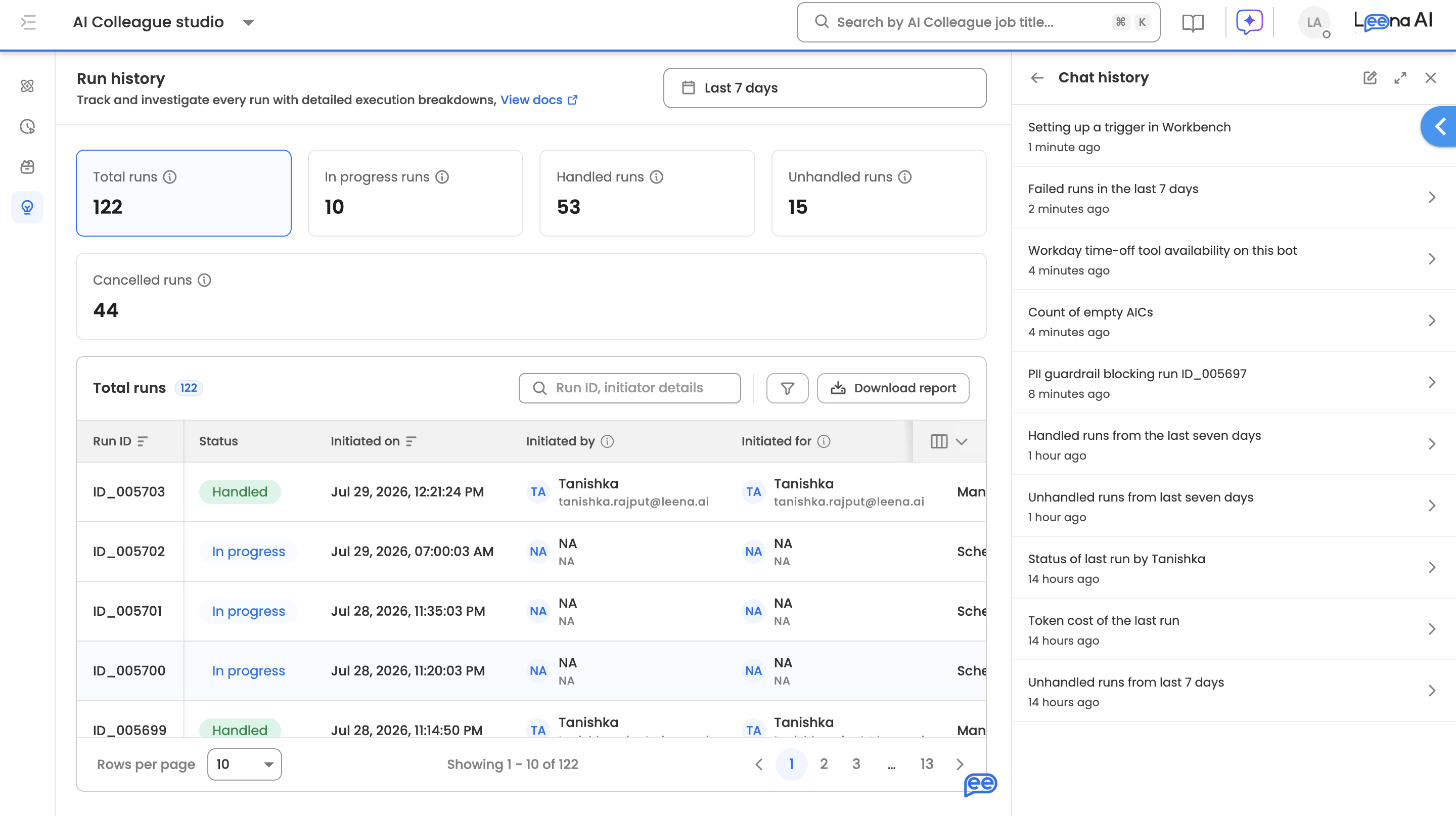
Studio Assist is not a single running conversation. You can keep as many separate chats as you like against a bot, switch between them, and come back to any of them later with the full thread intact. This is what lets you keep one chat per investigation instead of one ever-growing thread.
Panel header controls
| Control | What it does |
|---|---|
| History | Switches the panel to the Chat history list. The header title changes to Chat history and a back arrow returns you to the current chat. |
| New chat | Starts a fresh conversation. Your current chat is not lost — it stays in history. |
| Expand | Switches the panel to full screen and back. |
| Close | Closes the panel. Your conversation is preserved. |
Starting a new chat
Click New chat whenever you move to a new problem. Each chat carries its own context and its own thread, so a run-failure investigation does not get tangled up with a month-end reporting question. Reasons to start a new chat rather than continue:
- You are switching to an unrelated question
- The current thread has gone long and you want a clean starting point
- You want to keep a specific investigation separate for reference later
The Chat history list
Opening Chat history shows every conversation you have had with Studio Assist on the current bot, newest activity first.
Each row shows:
- Title — generated automatically from the first exchange (see below)
- Last activity — a relative timestamp, e.g. 25 minutes ago, 19 hours ago, 5 days ago
- A caret to open it
Scope. The list is scoped to you and to the bot you are currently in. You will not see other users' conversations, and switching bots shows that bot's history instead.
Scrolling. History loads the 30 most recent conversations first and pulls older ones automatically as you scroll — so a long history stays responsive. If an older page fails to load, an inline Retry row appears rather than silently stopping.
Reopening a chat. Clicking a row loads the full conversation back into the panel — every message, card, timeline and follow-up chip exactly as it was. You can continue the conversation from there. Note that Studio Assist re-reads your current page on the next message, so a chat reopened from a different page picks up the new context.
States you may see:
| State | Meaning |
|---|---|
| New chat as the row title | The title has not been generated yet — it fills in shortly, or on the next exchange |
| No chats found | You have not started a conversation on this bot yet |
| Failed to load chat history | The list could not be fetched — reopen the panel to retry |
Automatic titles
Conversations are titled automatically in the background from the first meaningful exchange, so history stays scannable without you naming anything. Titles are short (a few words), preserve product acronyms like AOP and AIC, and describe the specific topic — "Why request ID_000239 was unhandled", "Last run failure reason", "Debugging run Req_6a62064b…".
If the first exchange is too vague to title, the conversation stays as New chat and is titled on a later turn once the topic becomes clear.
Staying in sync
The history list refreshes when you open it, after a turn completes, and when you return to the browser tab — so a conversation started in another tab shows up without a page reload.
Not available today: renaming and deleting conversations from the panel. Both are planned; today a conversation stays in history once created.
Composer and feedback
Message length. A single message can be up to 5,000 characters. Over the limit, the composer shows an inline error with the overflow count and sending is blocked until you trim it.
Stop. While the assistant is working, the send button becomes a stop button. Press Esc or click stop to cancel the turn. (When nothing is streaming, Esc closes the panel instead.)
Recall your last message. Press the up arrow in an empty composer to bring back the message you last sent — useful for rephrasing a question that did not land.
Feedback. Every completed answer has a thumbs-up / thumbs-down and a copy control.
- Copy puts the answer on your clipboard as formatted text — what you see, not raw markdown. It is a local action; nothing is sent to Leena AI.
- Thumbs open a short inline flow: rate → "Tell us more" → pick tags and add an optional comment → done. You can skip the detail step, and clicking the active thumb again clears your rating.
Attachments are not available today. The attach-file control is switched off in the current release; ask your question as text. File attachments are planned for a future release.
Scope, limits and safeguards
Read-only. Studio Assist investigates and explains. It does not create, edit, publish, schedule or delete anything today. If you ask it to make a change, it will explain the limitation rather than attempt it. Write actions are planned for a future release and will require an explicit confirmation step before anything is committed.
Scoped to AI Colleagues. Questions about Knowledge Management, Notifications, Workflows Studio or Admin settings are out of scope and will be politely declined. AI Colleague how-to questions remain in scope.
Scoped to your bot. Every request is bound to the bot you are working in. Studio Assist cannot read data from another bot, regardless of how a question is phrased.
Scoped to your permissions. Studio Assist acts as you. It can only see what your dashboard role already allows you to see, and its activity is attributed to your user in audit logs.
One question at a time. Each conversation processes one turn at a time. Sending is blocked while an answer is still streaming — stop the current turn first if you want to change direction.
Response size caps. Very large results are truncated with a note rather than returned in full — narrow the question (add a date range, a status filter, a specific AI Colleague) to get a complete answer.
Unknown IDs. If a run, AOP or tool ID does not exist, Studio Assist tells you it could not find it and suggests how to search for the right one, rather than inventing an answer.
No inference. Studio Assist reports only what the underlying data actually contains. It will not guess at participants, versions, or source details it cannot retrieve, and it deliberately omits raw flagged PII values from guardrail results.
Troubleshooting
| What you see | What it means |
|---|---|
| The Studio assist icon is missing | You are not on an AI Colleagues page, or Studio Assist is not enabled for your region |
| The icon is there but nothing opens | Refresh the page; if it persists, raise a support ticket |
| An error banner at the top of the panel | The turn failed. Start a new chat or retry the question; if it repeats, raise a support ticket |
| Failed to load chat history | The history list could not be fetched — close and reopen the panel to retry |
| Couldn't load this chat | That conversation could not be loaded — start a new chat from the link shown |
| Send button stays greyed out | An answer is still streaming, or your message is over the 5,000-character limit |
| "I can't help with that" | The question falls outside AI Colleagues — see Scope above |
| An answer looks truncated | The result exceeded the display cap; narrow the question with a filter or date range |
Related pages
Updated about 2 months ago