
Voice
Voice orchestrator settings control how the assistant handles spoken conversations — how it listens, how it speaks, and how it behaves during a call.
The page has two sections: Transcription settings, which tune how employee speech is captured and interpreted, and Select voice, which chooses the voice the assistant replies in.
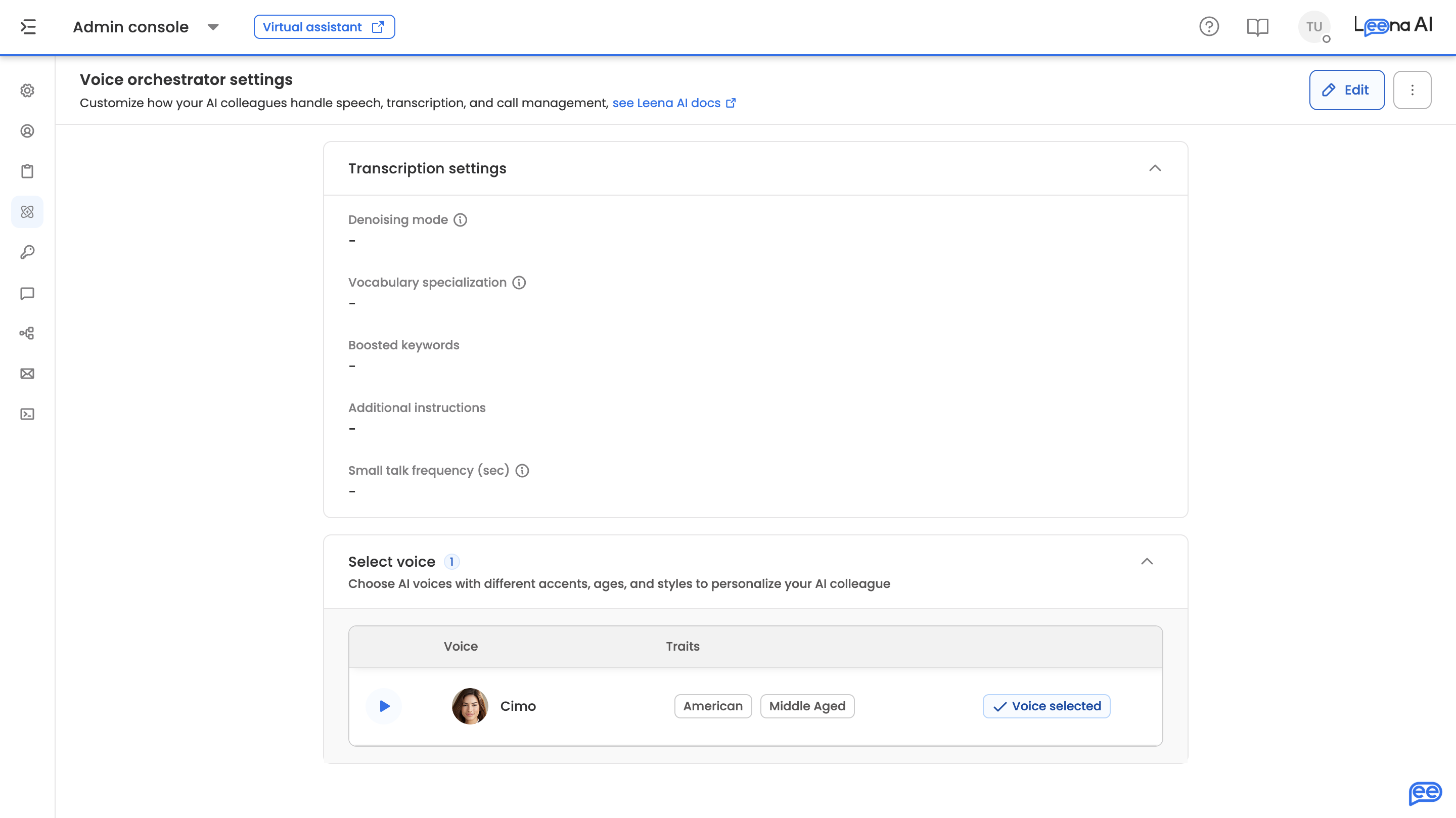
Where to find it
Open the Admin Console, then go to Orchestrator → Voice.
Access and prerequisitesVoice sits inside the Orchestrator group, so it is available to roles granted Orchestrator settings.
The virtual assistant must also be on the latest architecture (AIC). If it isn't, contact your Leena AI implementation contact before enabling voice.
Enabling voice
Until voice is switched on, the page shows a disabled state — Voice is disabled, with a prompt explaining that enabling it lets employees speak and receive spoken responses. Click Enable voice to turn it on. The settings below only become available once it is enabled.
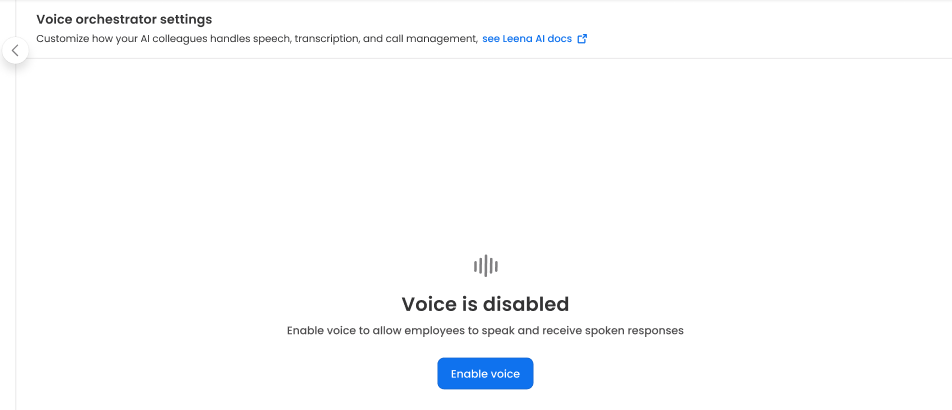
To turn it off again, use Disable voice orchestrator. A confirmation appears first, because disabling removes voice calling for the whole organization and it has to be switched back on manually — there is no automatic recovery.
Editing settings
The page opens read-only. Click Edit to make changes, then Save to apply them or Cancel to discard them. Both sections are accordions and are expanded by default.
Transcription settings
These tune the quality and behaviour of speech-to-text during a call.
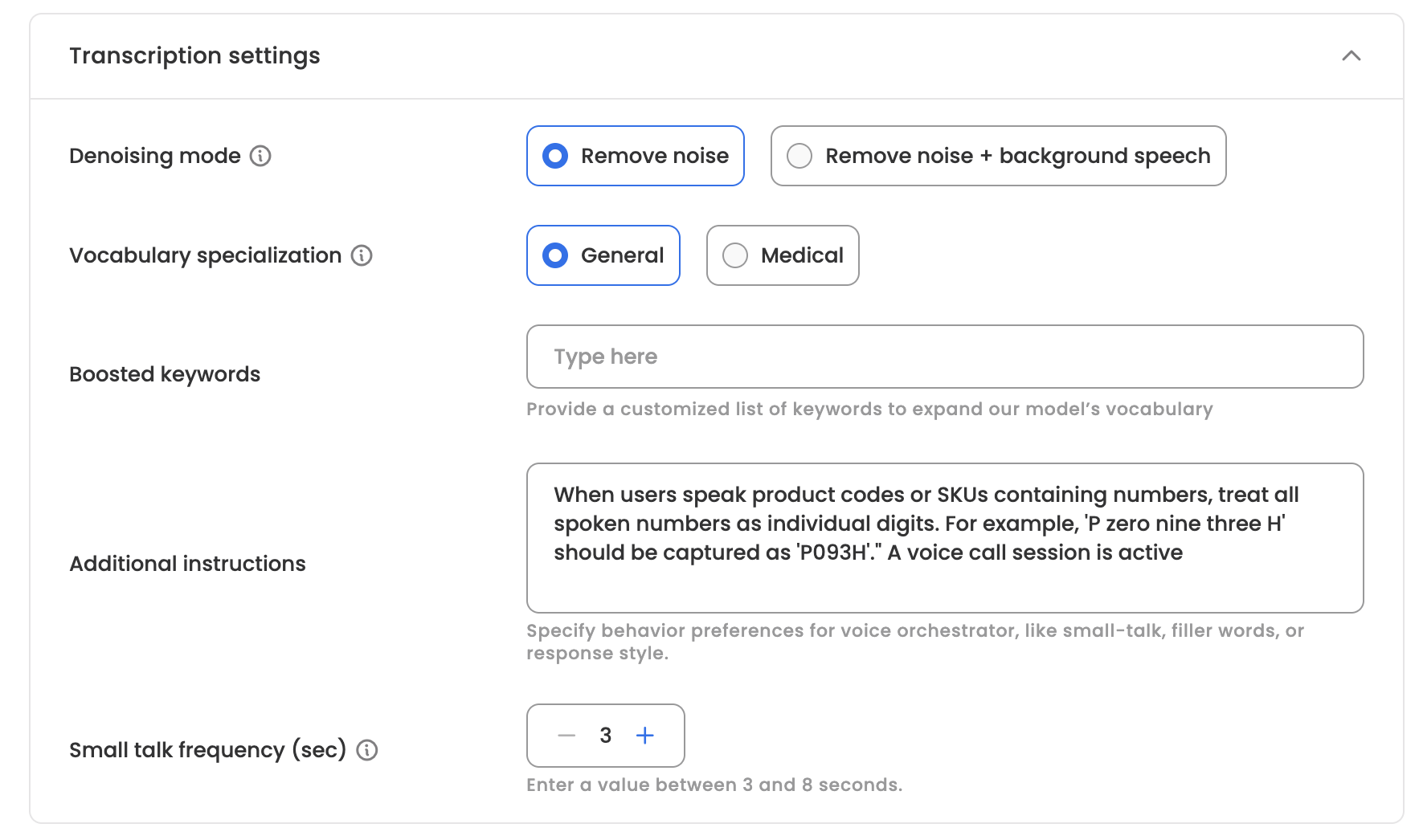
| Setting | What it does |
|---|---|
| Denoising mode | Filters unwanted sound out of the input. Remove noise strips ambient environmental noise. Remove noise + background speech additionally suppresses other people audible nearby — the right choice for open-plan offices and shared spaces |
| Vocabulary specialization | The vocabulary set used for transcription. General suits most enterprise deployments; Medical is tuned for medical terminology |
| Boosted keywords | A custom list of words added to the model's vocabulary, so it recognises terms it would otherwise mishear |
| Additional instructions | Free-text guidance on how the voice orchestrator should behave — handling of small talk, filler words, response style, or input formats such as reading alphanumeric codes digit by digit |
| Small talk frequency (sec) | How readily the assistant fills idle moments with small talk |
Boosted keywords
Use this for anything the default model is unlikely to know: product codes, internal acronyms, team or system names, employee ID formats. It is the single most effective fix when the assistant consistently mishears a specific term.
You can add up to 100 keywords. Beyond that, the field asks you to remove existing entries before adding more.
Additional instructions
Free text, up to 1000 words. Longer entries are rejected on save.
Small talk frequency
Set in seconds, from 3 to 8, adjusted with the stepper controls rather than typed. The default is 3.
Lower means more small talkThe value is a threshold on idle time, not a rate — so a lower number produces small talk more often, and a higher number less often. Setting 8 makes the assistant noticeably quieter during pauses than the default of 3.
Select voice
Choose the voice the assistant speaks in. Voices span a range of accents, genders, and age styles, so you can match the assistant to your users.
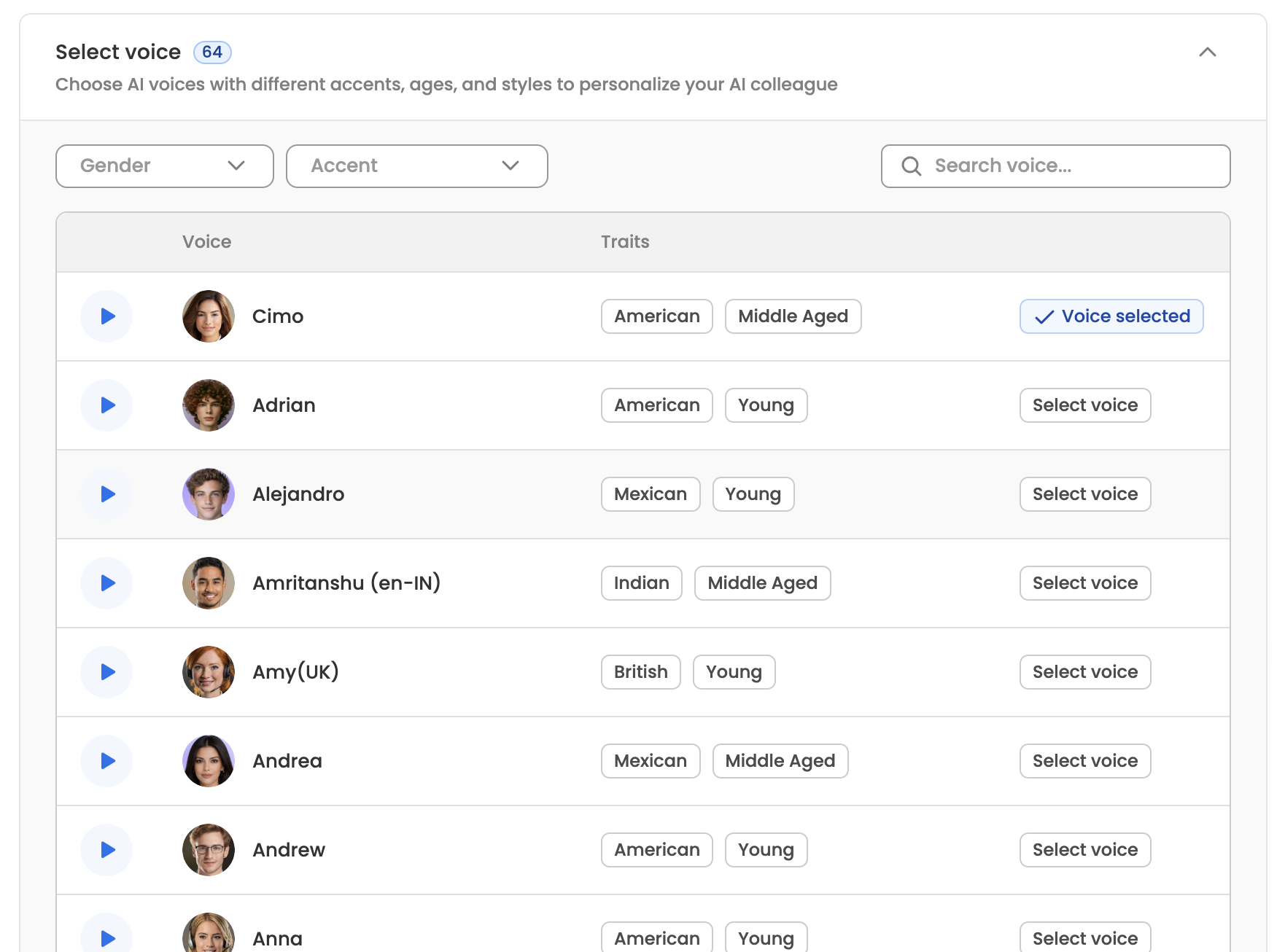
The section header shows how many voices are available. Narrow the list using the gender and accent filters, or search — search matches on accent and age as well as name.
| Column | What it shows |
|---|---|
| Sample | Preview button. Plays a clip of the voice |
| Avatar | Visual avatar for the voice |
| Voice | The voice name |
| Accent | For example American, British, Indian, Mexican |
| Gender | The voice's gender |
| Age | Age style, such as Young or Middle Aged |
Use Select voice on a row to make it active. The current voice is marked Voice selected. In read-only mode the table shows just the active voice rather than the full list.
Updated 26 days ago